Israeli Democracy vs. Arab Apartheid [AT]
Israeli Democracy vs. Arab Apartheid
By JanSuzanne Krasner
October 26, 2011
It is a falsehood to say that Israel is an apartheid state. This indictment, made by Mahmoud Abbas repeatedly in his speeches, is an Orwellian distortion of the truth, but it has been extremely effective in the public relations war of words that plays out in the United Nations, on the international stage, in the media, and on college campuses every day.
This is a grave and toxic travesty that needs to be made right. In light of the "Arab Spring" spreading seeds of sharia law throughout the Middle East, Western civilization needs to see the truth. Americans are being hijacked by propaganda against Israel...and not defending Israel's right to be a Jewish state will lead to our own eventual downfall.
The analogy of Israel to South African apartheid commands a response. Because of its catchy, slick word combination and its connotations that evoke vivid images of human unfairness and suffering, it has became a fashionable narrative for the media and international community's discourse. But it is not factual, and it is very deceptive.
Labeling Israel "apartheid" is meant to provoke worldwide criticism and elicit human rights-based anger that sanctions demonstrations, boycotts, and the denigration of Jewish morals. This finger-pointing is an intentional attack on Israel. It condones terror in the guise of "freedom-fighters," encourages prosecution of Israeli officials in foreign courts, promotes laws against Israeli goods, and supports boycotts of stores selling Israeli products. It sees the advantage of kidnapping soldiers, allows the destruction of Jewish artifacts and religious sites, and tries to exclude Jews from their legitimate claim to their historic homeland.
Factually speaking, apartheid was the policy of the South African government as a way of dealing with the white and non-white social, political and economic issues up until 1992. It was the official policy that established and maintained racial segregation and racial discrimination. The South African non-whites could not vote, and they had to carry a "Pass Book," or they risked being jailed or deported. By contrast, all citizens of Israel have equal voting rights. Arabs have eleven representatives in Israel's Knesset, including an Arab on the Israeli Supreme Court. Every citizen must carry an identity card, along with all legal residents.
In addition, non-white South Africans were kept from a wide range of jobs. They had no free elementary through high school education; mixed sexual relationships were restricted and segregated; hospital and ambulance services were segregated; they could not use most public amenities; sports were segregated; and public facilities were labeled for correct racial usage. Non-whites could not enter a building through the main entrance, be a member of a union, or participate in a strike. That is apartheid, and Israel is not an apartheid state.
Although many pro-Palestinian organizations are aware that the Israel-apartheid analogy is inaccurate, this rhetoric is continually used to condemn and isolate Israel. Just visit Israel to see the truth...Israeli Arabs shopping at Jerusalem's Mamila Mall, enjoying Tel Aviv beaches, enrolled in the universities, getting hospital care, going on school trips to the zoos, and having free access to public places.
One of the more outspoken defenders of Israel is Benjamin Pogrund, a Jew born in Cape Town, now living in Israel. Pogrund lived under apartheid, and as an anti-apartheid activist, he took grave risks by reporting the injustices against blacks. He often comments that the comparison of Israel to South African apartheid "greatly minimizes the oppression and misery caused by apartheid and is debasing to its victims."
In his rebuttal, Pogrund argues that "Israel is not unique in declaring itself a state for a specific people."
Everyone knows that Egypt is for Egyptians, Ireland is for Irishmen, France for Frenchmen, Italy is for Italians, Serbia for Serbs, China for the Chinese, Iran for the Persians...and the list goes on.
"Apartheid"-supporters substantiate their stance by claiming that Israel discriminates against Israeli Arabs by barring them from buying land.
The facts regarding land ownership are clarified by Mitchell Bard, the executive director of the non-profit American-Israeli Cooperative Enterprise (AICE) and a foreign policy analyst who frequently lectures on U.S.-ME policy:
In the early part of the century, the Jewish National Fund was established by the World Zionist Congress to purchase land in Palestine for Jewish settlement. This land, and that acquired after Israel's War of Independence, was taken over by the government. Of the total area of Israel, 92% belongs to the State and is managed by the Land Management Authority. It is not for sale to anyone, Jew or Arab. The remaining 8% of the territory is privately owned. The Arab Waqf (the Muslim charitable endowment), for example, owns land that is for the express use and benefit of Muslim Arabs. Government land can be leased by anyone, regardless of race, religion or sex. All Arab citizens of Israel are eligible to lease government land.
The reality is that both Arabs and Jews build homes illegally throughout Israel. And the fact is that the number of illegal Arab homes scheduled for demolition is miniscule compared to Jewish homes that must adhere scrupulously to the rules for fear of condemnation. (Please check Bard's point-by-point rebuttal.)
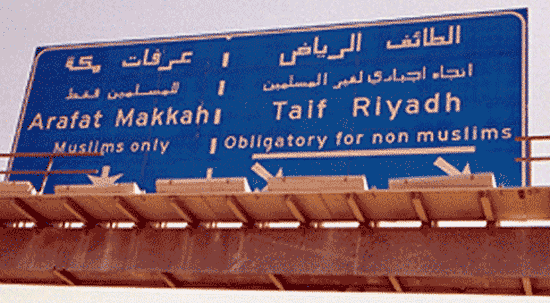
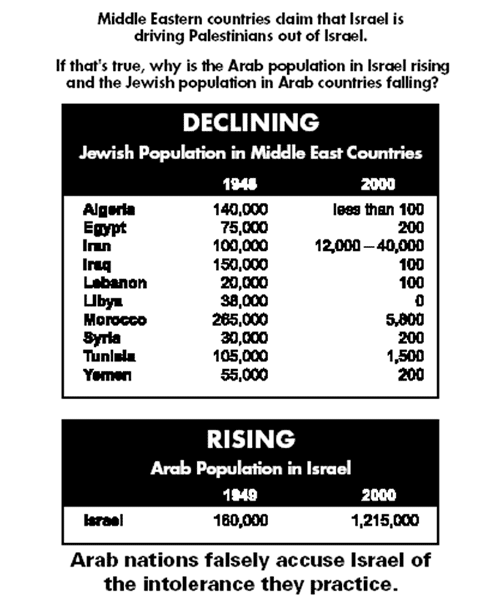
The problems in Israel's Arab communities are much like conditions others face in various places in the world, but Arabs don't point a finger at those places. Only Israel is labeled and attacked as "apartheid." Arabs need only to look at their neighboring countries in the Middle East to find real apartheid. Does anyone honestly believe that Muslim women do not suffer from apartheid in countries with sharia law? Or that Christians and Jews in some Arab nations are being attacked and killed purely because of their religion? More pointedly, both Jordan and Saudi Arabia do not allow Jews to live there, and Saudi Arabia doesn't even let Jews visit.
There are many "no-class" citizens in the world that Arabs don't care to talk about. One must believe that Abbas just doesn't recognize "apartheid" as he declares that the State of Palestine will be "Judenrein" -- a Jewish-free state. Instead, the label of "apartheid" is stuck on Israel, keeping eyes focused away from the intolerance and bigotry that the PLO and Hamas preach.
Recently, I took issue with "Students for Justice in Palestine" (SJP), an on-campus pro-Palestinian organization that orchestrated the first National Anti-Israel Conference at Columbia University to "educate" students for participation in "Israel Apartheid Week 2012" on university campuses.
The SJP supports the Apartheid Movement, the Gaza Freedom Movement that tried to break the Israeli-Egyptian blockade, the BDS movement against Israeli goods, and a One-State Solution with the "Right of Return." There can be no doubt that SJP, hiding behind the veil of human rights activism, supports the end of a Jewish state while "freedom-fighting" terrorists try to accomplish the same goal through violence.
One question needs to be asked of all those who accuse Israel of being an apartheid state: if Israel gave up all the land rights, forfeited all of the natural resources, and agreed to a One-State Solution with the "Right of Return," would the Jews be able to live in peaceful coexistence with their Arab neighbors? The answer to this question determines the fate of the Jewish people and whether peace is ever attainable.
http://www.americanthinker.com/2011/10/israeli_democracy_vs_arab_apartheid.html
Tags: "palestine", Apartheid, apartheid slur, Arab apartheid, Arab Apartheid State of Palestine, Arab racism, Arabs, human rights, Islamic apartheid, Islamic bigotry, Israel, Israeli democracy Vs Arab Apartheid, Jews, Judenrein, Mahmoud Abbas, Muslims, myths and facts, non arabs, non Muslims, Pallywood, racism, UN
Labels: apartheid slur, arab apartheid, Israel palestine 101
The United Nations Should Not Recognize an Apartheid, Judenrein, Islamic Palestine
The United Nations Should Not Recognize an Apartheid, Judenrein, Islamic Palestine :: Hudson New York
by Alan M. Dershowitz
September 21, 2011 at 11:30 am
The United Nations is being asked to grant the Palestinians the status of a "state," for at least some purposes. The question arises what kind of a state will it be? In an effort to attract Western support, the Palestinian Authority claims that it will become another "secular democratic state." Hamas, which won the last parliamentary election, disagrees. It wants Palestine to be a Muslim state governed by Sharia Law.
We know what the Palestinian leadership is saying to the West. Now let's look at what its saying to its own people, who will, after all, be the ultimate decision makers if Palestine is indeed a democracy.
The draft constitution for the new state of Palestine declares that "Islam is the official religion in Palestine." It also states that Sharia Law will be "the major source of legislation." It is ironic that the same Palestinian leadership which supports these concepts for Palestine refuses to acknowledge that Israel is the nation state of the Jewish people. Israel, in contrast to the proposed Palestinian state, does not have an official state religion. Although it is a Jewish state, that description is not a religious one but rather a national one. It accords equal rights to Islam, Christianity and all other religions, as well as to atheists and agnostics. Indeed, a very high proportion of Israelis describe themselves as secular.
The new Palestinian state would prohibit any Jews from being citizens, from owning land or from even living in the Muslim state of Palestine. The Ambassador of the PLO to the United States was asked during an interview whether "any Jew who is inside the borders of Palestine will have to leave?" His answer: "Absolutely!" After much criticism, the Ambassador tried to spin his statement, saying that it applied only to Jews "who are amid the occupation." Whatever that means, one thing is clear: large numbers of Jews will not be welcome to remain in Islamic Palestine as equal citizens. In contrast, Israel has more than 1 million Arab citizens, most of whom are Muslims. They are equal under the law, except that they need not serve in the Israeli army.
The new Palestine will have the very "law of return" that it demands that Israel should give up. All Palestinians, no matter where they live and regardless of whether they have ever set foot in Palestine, will be welcome to the new state, while a Jew whose family has lived in Hebron for thousands of years will be excluded.
To summarize, the new Palestinian state will be a genuine apartheid state. It will practice religious and ethnic discrimination, it will have one official religion and it will base its laws on the precepts of one religion. Imagine what the status of gays will be under Sharia law!
Palestinian leadership accuses Israel of having roads that are limited only to Jews. This is entirely false: a small number of roads on the West Bank are restricted to Israelis, but they are equally open to Israeli Jews, Muslims and Christians alike. The entire state of Palestine will have a "no Jews allowed" sign on it.
It is noteworthy that the very people who complain most loudly about Israel's law of return and about its character as the nation state of the Jewish people, are silent when it comes to the new Palestinian state. Is it that these people expect more of Jews than they do of Muslims? If so, is that not a form of racism?
What would the borders of a Palestinian state look like if the Palestinians got their way without the need to negotiate with Israel? The Palestinians would get, as a starting point, all of the land previously occupied by Jordan prior to the 1967 War, in which Jordan attacked Israel. This return to the status quo that led to the 6 Day War is inconsistent with the intention of Security Council Resolution 242, which contemplated some territorial changes.
The new boundaries of this Palestinian state would include Judaism's holiest place, the Western Wall. It would also include the access roads to Hebrew University, which Jordan used to close down this great institution of learning founded by the Jews nearly 100 years ago. The new Palestinian state would also incorporate the Jewish Quarter of Jerusalem, in which Jews have lived for 3000 years, except for those periods of time during which they were expelled by force.
It is contemplated, of course, that Israel would regain these areas as part of a land swap with the Palestinians. But there is no certainty that the Palestinians would agree to a reasonable land swap. Palestinian leaders have already said that they would hold these important and sacred sites hostage to unreasonable demands. For example, the Western Wall covers only a few acres, but the Palestinian leadership has indicated that these acres are among the most valuable in the world, and in order for Israel to regain them, they would have to surrender thousands of acres. The same might be true of the access road to Hebrew University and the Jewish Quarter.
When Jordan controlled these areas, the Jordanian government made them Judenrein—Jews could not pray at the Western Wall, visit the Jewish Quarter, or have access to Hebrew University. There is no reason to believe that a Palestinian state would treat Jews any differently if they were to maintain control over these areas.
An Apartheid, Islamic, Judenrein Palestine on the 1967 borders is a prescription for disaster. That is why a reasonable Palestinian state must be the outcome of negotiations with Israel, and not the result of a thoughtless vote by the United Nations.
The Palestinians and Israeli leaders are now in New York. Israeli Prime Minister Benjamin Netanyahu has offered to sit down and negotiate, with no preconditions, a realistic peace based on a two-state solution. President Abbas should accept that offer, which will actually get the Palestinians a viable state rather than a cheap paper victory that will raise expectations but lower the prospects for real peace.
http://www.hudson-ny.org/2442/united-nations-palestine
Push for Palestinian state at UN must be rejected: It will hurt Arabs and Jews alike
New York Daily News - Alan Dershowitz - Wednesday, September 21st 2011, 4:00 AM
An apartheid, Islamic, Judenrein Palestine based on the 1967 borders is a prescription for disaster. That is why a reasonable Palestinian state must be the ...
http://www.nydailynews.com/opinions/2011/09/21/2011-09-21_push_for_
palestinian_state_at_un_must_be_rejected_it_will_hurt_arabs_and_jews_al.html
Inernational: From Israel to New York - Jews, Christians Protest Hamas Led ... Israel News Agency
By Joel Leyden
Israel News Agency
New York --- September 20, 2011 .... Thousands of Jewish and Christian protesters are taking to the streets in Jerusalem and in New York to protest a UN vote on the creation of a Hamas led Palestine...
The issue is not a vote at the UN. The issue is that of an all out PR campaign of incitement and violence coordinated by Iran, Syria, Hamas, Islamic Jihad and Hezbollah which will transcend into a regional war in the Middle East.
The Israel Defense Forces are preparing for mass riots as the Israel Defense Forces Home Front Command prepares bomb shelters for it's citizens.
Mark Regev, spokesman for the Israel Prime Minister Benjamin Netanyahu, criticized the Palestinian effort last Friday, calling it a violation of the Oslo Accords, the 1993 agreement between Israel and the PLO.
"The Palestinians made a commitment to Israel and the world, to resolve all outstanding issues through negotiations. The Palestinians are violating their signed commitments."
Regev also threatened the PA, saying that if they proceed with their UN action either with the General Assembly or the Security Council, "Israel will reserve the right to respond in kind". Several Israel lawmakers have suggested responding by annulling the accords or by annexing all or part of the entire West Bank. The West Bank, which never belonged to any entity known as Palestine, belonged to Jordan before the 1967 war.
While many protest a UN vote for a Palestine that has openly stated that it would not allow Jews inside their country, a state of Apartheid, Americans are also out in the streets protesting the arrival of Iran President Mahmoud Ahmadinejad. The New York based advocacy group United Against Nuclear Iran, is protesting outside the Warwick Hotel in Manhattan where Ahmadinejad is staying.
"Ahmadinejad is the leader of a criminal regime allied with al-Qaeda and other terrorists, and guilty of atrocious human rights violations," the group said in a statement. "Would the Warwick be willing to accommodate Osama bin Laden's successor Ayman al-Zawahiri were he to visit Manhattan?"
http://www.israelnewsagency.com/unprotestsdemonstrationshamas
palestinepaabbasnetanyahuvoteterrorism
israeljewishchristianswarislamicjihadi
ransyriafacebookgroupusidfwar48092011.html
Tags: Abbas, Apartheid palestine, Arab apartheid, Arab immigration into palestine, Arab racism, Arabs, Ethnic Cleansing, ethno-religious cleansing, Fatah, genocide, Hamas, Hezbollah, Islam, Islamic apartehid, Islamic Bigotry, Islamofascism, Jews, Jihad, judenrein, judenrein Palestine, Muslims, Palestine, Palestinians, Politics, Religion, religious cleansing, UN, United Nations, violence, war on terror, Zionism
Labels: arab apartheid, Ethnic cleansing, Islamic apartheid, Israel palestine 101, Judenrein
Jul. 2010, Sep. 2011: Two important dates in 'official' ethno-religious cleansing, judenrein, apartheid Arab Palestine
Jul. 2010, Sep. 2011
Two important dates in 'official' ethno-religious cleansing, judenrein, apartheid Arab Palestine
July 28, 2010 - "Palestinian" racist leader, PM Mahmoud Abbas on a 'Jew free' region, even banning Jews under NATO. The "Palestinian" media [PALLYWOOD] later edited the word "Jew" for "Israeli," though it doesn't really make sense in the context...
---
Arab League Tries to Score Points for Abbas, 'Endorses' Talks
Arab League letter 'endorses' direct talks, while leaving preconditions that prevent them. 'No Jews allowed' in Abbas' planned state.
By Maayana Miskin and R. Sylvetsky
First Publish: 7/29/2010, 8:08 PM / Last Update: 7/29/2010, 9:45 PM
http://www.israelnationalnews.com/News/News.aspx/138856
No outcry at Abbas's racism? The Jewish Chronicle
Aug 19, 2010 ... Speaking in Cairo on July 28, Abbas gave his version of negotiations with Israel's former Prime Minister, Ehud Olmert. In the course of his remarks, Abbas made a statement so astonishing that I quote it in full, as reported by Wafa, the official Palestinian news agency: "I'm willing to agree to a third party that would supervise the agreement, such as Nato forces, but I would not agree to having Jews among the Nato forces, or that there will live among us even a single Israeli on Palestinian land."
http://www.thejc.com/comment-and-debate/columnists/37008/no-outcry-abbass-racism
Israel Has Always Been A Jewish State The Jewish Week
Menachem Z. Rosensaft Tuesday, August 30, 2011
While the Obama administration is trying to ward off the Palestinians’ ill-conceived bid for unilateral recognition as an Arab state at the UN General Assembly, Palestinian Authority President Mahmoud Abbas is proving to be as obstructionist and hypocritical as his late predecessor, Yasir Arafat. “Don’t order us to recognize a Jewish state,” Abbas declared last week. “We won’t accept it.”
Never mind that he envisions an Arab Palestine that is Judenrein (that is, free of Jews). “I’m willing to agree to a third party that would supervise [an Israeli-Palestinian peace agreement], such as NATO forces, but I would not agree to having Jews among the NATO forces, or that there will live among us even a single Israeli on Palestinian land,” Abbas said in Cairo on July 28, 2010.
Never mind that Iran, Pakistan and Afghanistan, as well as Mauritanian in West Africa for that matter, are all officially “Islamic Republics,” that Egypt and Syria call themselves “Arab Republics,” that Jordan by its own definition is a “Hashemite,” meaning directly descendant of the Prophet Muhammad, kingdom, and that the website of the Royal Embassy of Saudi Arabia proclaims that country to be “a modern nation that adheres to Islam, honors its Arab heritage and tradition, and presses vigorously forward in the service of Islam ….”
According to Abbas’ Islamocentric geopolitical ethos, Arabs are entitled to a myriad of Muslim states scattered across the Middle East and North Africa, but he will not countenance a single Jewish state in his neighborhood.
In fact, the international community recognized Israel as a Jewish state long before Abbas and his cohorts ever came on the scene.
On Oct. 11, 1947, Hershel V. Johnson, the United States deputy representative to the United Nations, explained at a meeting of the UN Special Committee on Palestine that “as a result of the First World War, a large area of the Near East, including Palestine, was liberated and a number of states gained their independence. The United States, having contributed its blood and resources to the winning of that war, felt that it could not divest itself of a certain responsibility for the manner in which the freed territories were disposed of, or for the fate of the peoples liberated at that time. It took the position that, these peoples should be prepared for self-government and also that a national home for the Jews should be established in Palestine.” (Emphasis added.)
Moreover, Johnson continued, “in 1917 the Government of the United Kingdom, in the statement known as the Balfour Declaration,..
[...]
http://www.thejewishweek.com/editorial_opinion/opinion/israel_has_always_been_jewish_state
Beware Palestinian apartheid [Ynet, Oct. 4, 2010]
Op-ed: Palestinian leader Abbas seeks to adopt racist policy based on ethnic cleansing of Jews
Jonathan Dahoah Halevi Published: 08.04.10, 00:03
[...]
"I'm willing to agree to a third party that would supervise the agreement, such as NATO forces, but I would not agree to having Jews among the NATO forces, or that there will live among us even a single Israeli on Palestinian land," he was quoted by Wafa, the official Palestinian news agency.
A state without Jews
The Palestinians intend to demand the implementation of the UN resolution regarding refugees, from a Palestinian perspective, which gives the 5.5 million refugees and their descendants the right of return and to settle in the State of Israel. In his briefing to the Egyptian media, Abbas presented this strategy and denied the Jewish character of Israel. He maintains that Israel should, in fact, become a bi-national state, but on the other hand that Palestine must become a state "clean" of Jews.
The term "Israeli" used by Abbas means "Jew," as the PA sees Israeli Arabs, Muslims and Christians alike as an integral part of the Palestinian people. The future State of Palestine, according Abbas, must resist any Jewish presence in its territory. In other words, the PA embraces a racist policy – Palestinian apartheid – directed at Jews, based on denial of Jewish history and the cultural and religious linkage of the Jewish people to the land.
The anti-Semitism embodied in Abbas’ words refers also to his position towards the NATO observers’ force that may be deployed in the West Bank to monitor the implementation of the peace agreement with Israel. He is opposed to Jews being included in this force; meaning, he will ask Germany and all other partner countries in NATO to use their own forces in the West Bank, in an effort to the exclude any Jewish soldiers.
He didn’t explain how these countries would determine who is a Jew, whether according to orthodox Jewish laws or just if one of the parents or grandparents was a Jew. But even Saudi Arabia didn’t dare oppose the deployment of American Jewish soldiers on its land during operation Desert Storm (1990-1), and no one in Israel ever demanded to disqualify Muslim soldiers from serving in the international observers’ forces in Lebanon, the Golan Heights and Sinai.
The racist language used by Abbas is particularly despicable as it doubts the loyalty of the Jews to their country. It is for this reason that his comments call for a firm Israeli and European response.
Note: Wafa, the official Palestinian news agency published on July 28 its version of Abbas’ briefing to the Egyptian media, quoting him as saying: "I'm willing to agree to a third party that would supervise the agreement, such as NATO forces, but I would not agree to having Jews among the NATO forces, or that there will live among us even a single Israeli on Palestinian land". This version was reprinted by Palestinian newspapers al-Quds and al-Hayat al-Jadida on July 30 and by other Arab newspapers.
http://www.ynetnews.com/articles/0,7340,L-3929819,00.html
---
Sep. 13, 2011 - Palestinian Liberation Organization (PLO) ambassador to the US Maen Areikat on its policy of 'Jew free' "Palestine" State
Judenrein Palestine 3:11 PM, Sep 14, 2011 - By DANIEL HALPER
The Palestine Liberation Organization's ambassador to the United States said Tuesday that any future Palestinian state it seeks with help from the United Nations and the United States should be free of Jews.
[...]
Such a state would be the first to officially prohibit Jews or any other faith since Nazi Germany, which sought a country that was judenrein, or cleansed of Jews, said Elliott Abrams, a former U.S. National Security Council official.
I was at this breakfast, and as the so-called ambassador was leaving and getting into his Cadillac, I asked whether he was endorsing an apartheid state.
http://www.weeklystandard.com/blogs/judenrein-palestine_593537.html
Palestinians: No Jews in our state
Israel Today - Ryan Jones - Sep 15, 2011
... it appears it is the Palestinians who seek apartheid. ...[Areikat's] comments conjure up Judenrein motifs." Judenrein was the term used by the Nazis to ...
http://www.israeltoday.co.il/News/tabid/178/nid/22948/language/en-US/Default.aspx
CAMERA Snapshots: Apartheid Palestine - Not in Washington Post and New York Times
Sep. 14, 2011 - The Palestine Liberation Organization's representative to Washington, Maen Areikat, told American reporters that a future West Bank and Gaza ...
http://blog.camera.org/archives/2011/09/apartheid_palestine_not_in_was.html
Lieberman Orders Embassies to 'Protest PA Apartheid State'
FM Lieberman has instructed Israeli embassies around the world to protest remarks by a PA official that 'Palestine' will be 'Judenrein'
By David Lev
First Publish: 9/15/2011, 2:18 PM
Foreign Minister Lieberman (file)
Israel news photo: Flash 90Foreign Minister Avigdor Lieberman has instructed Israeli embassies in Europe and the U.S. to file strong protests with the governments of their host countries against comments by the Palestinian Authority representative delegation's United Nations observer, who said that the Arab state the PA plans to declare in Judea, Samaria and Jerusalem will be “free of Jews.”
http://www.israelnationalnews.com/News/News.aspx/147927
Tags: "palestine", Abbas, anti semitism, Apes and Pigs, Arab anti-Semitism, Arab lobby, Arab oil, Arab racism, Arabs, Areikat, dhimmis, ethnic cleasning, ethno-religious cleansing, grandchildren of Arab immigrants, History, infidels, Islamic bigotry, Islamic Lobby, Islamofascism, Israel, Jew-hatred, Jews, Jihad, Jul. 2010, Maen Areikat, Mahmoud Abbas, Muslim anti-Semitism, Muslims, NATO, non arabs, non Muslims, Palestine Arab apartheid, Pallywood, religious cleansing, PLO, racism Sep. 2011, so called 'palestinians', United Nations
Labels: arab apartheid, history, Israel palestine 101, Judenrein
The Arab Apartheid (Ben Dror Yemini)
The Arab Apartheid
By Ben Dror Yemini
Maariv (translated from Hebrew)
May 14, 2011
The real “nakba,” which is the story of the Arab apartheid. Tens of millions, among them Jews, suffered from the “nakba,” which included dispossession, expulsion and displacement. Only the Palestinians remained refugees because they were treated to abuse and oppression by the Arab countries. Below is the story of the real “nakba”
In 1959, the Arab League passed Resolution 1457, which states as follows: “The Arab countries will not grant citizenship to applicants of Palestinian origin in order to prevent their assimilation into the host countries.” That is a stunning resolution, which was diametrically opposed to international norms in everything pertaining to refugees in those years, particularly in that decade. The story began, of course, in 1948, when the Palestinian “nakba” occurred. It was also the beginning of every discussion on the Arab-Israeli conflict, with the blame heaped on Israel, because it expelled the refugees, turning them into miserable wretches. This lie went public through academe and the media dealing with the issue.
In previous articles on the issue of the Palestinians, we explained that there is nothing special about the Israeli Arab conflict. First, the Arab countries refused to accept the proposal of partition and they launched a war of annihilation against the State of Israel which had barely been established. All precedents in this matter showed that the party that starts the war - and with a declaration of annihilation, yet - pays a price for it. Second, this entails a population exchange: indeed, between 550,000 and 710,000 Arabs (the most precise calculation is that of Prof. Ephraim Karash, who calculated and found that their number ranges between 583,000 and 609,000). Most of them fled, a minority were expelled because of the war and a larger number of about 850,000 Jews were expelled or fled from Arab countries ( the “Jewish nakba”). Third, the Palestinians are not alone in this story. Population exchanges and expulsions were the norm at that time. They occurred in dozens of other conflict points, and about 52 million people experienced dispossession, expulsion and uprooting (”And the World is lying”). And fourth, in all the population exchange precedents that occurred during or at the end of an armed conflict, or on the backdrop of the establishment of a national entity, or the disintegration of a multinational state and the establishment of a national entity - there was no return of refugees to the previous region, which had turned into a new national state. The displaced persons and the refugees, with almost no exceptions, found sanctuary in the place in which they joined a population with a similar background: the ethnic Germans who wore expelled from Central and Eastern Europe assimilated in Germany, the Hungarian refugees from Czechoslovakia and other places found sanctuary in Hungary, the Ukrainians who were expelled from Poland found sanctuary in Ukraine, and so forth. In this sense, the affinity between the Arabs who originated in mandatory Palestine and their neighbors in Jordan, Syria and Lebanon, was similar or even greater than the affinity between many ethnic Germans and their country of origin in Germany, sometimes after a disconnect of many generations.
Only the Arab states acted completely differently from the rest of the world. They crushed the refugees despite the fact that they were their coreligionists and members of the Arab nation. They instituted a régime of apartheid to all intents and purposes. So we must remember that the “nakba” was not caused by the actual dispossession, which had also been experienced by tens of millions of others. The “nakba” is the story of the apartheid and abuse suffered by the Arab refugees (it was only later that they became “Palestinians”) in Arab countries.
Egypt:
Throughout many eras, there was no real distinction between the inhabitants of Egypt and the inhabitants of the coastal plain. Both were Muslims, Arabs, who lived under Ottoman rule. According to the researcher Oroub El-Abed, commercial ties, mutual migration and intermarriage between the two groups was commonplace. Many of the residents of Jaffa were defined as Egyptians because they arrived in many waves, like the wave of immigration to Jaffa during the rule of Muhammad Ali and his son over many parts of the coastal plain. Inhabitants of the Ottoman Empire, which became mandatory Palestine, did not have an ethnic or religious identity that differed from that of the Egyptian Arabs.
Various records from the end of 1949 show that 202,000 refugees went to the Gaza Strip, primarily from Jaffa, Beer Sheva and Majdal (Ashkelon). That number may be exaggerated because the local poor also joined the list of aid recipients. The refugees went to the place where they were part of the majority group from all standpoints: ethnic, national and religious. Egypt, however, did not think so. At first, back in September 1948, a “government of all Palestine” was established, headed by Ahmad al-Baki. However, it was an organization under Egyptian auspices due to the rivalry with Jordan. The ostensible Palestinian government gave up the ghost after a decade.
What happened to the people in the Gaza Strip? How did the Egyptians treat them? Strangely, there is almost no research dealing with those days. But it is a bit difficult to hide that not so distant past. The Gaza Strip became a closed camp. It became almost impossible to leave Gaza. Severe restrictions were imposed on the Gazans (the originals and the refugees) in everything connected with employment, education and other matters. Every night there was a curfew until dawn the next day. There was only one matter in which the Egyptians assisted to the best of its ability: the school books contained serious incitement against Jews. Already in 1950, Egypt notified the UN that “due to the population crowding,” it would not be possible to assist the Palestinians by resettling them. That was a dubious excuse. Egypt thwarted the UN proposal to resettle 150,000 refugees in Libya. Many of the refugees who had fled in the earlier stages and were within Egypt were also forced to move to the giant concentration camp that was forming in the Gaza Strip. In effect, all the settlement arrangements proposed for resettling the refugees were blocked by the Arab countries.
Despite the absolute isolation, there is testimony about what happened in the Gaza Strip during those years. The important American journalist Martha Gellhorn paid a visit to the refugee camps in 1961. She also went to the Gaza Strip. It wasn’t simple. Gellhorn described the bureaucratic ordeal involved in obtaining an entry permit to the Gaza Strip and the days of waiting in Cairo. She also described the “sharp contrast between the amiability of the clerks, and the anti-Semitic propaganda that blossomed in Cairo.” “The Gaza Strip is not a hole,” Gellhorn stated, “but rather one big prison. The Egyptian government and is the warden.” She described a harsh military régime with all the elite of the Gaza Strip expressing enthusiastically pro-Nasser positions. Thus, for example, “For 13 years (1948-1961) only 300 refugees managed to obtain temporary exit visas.” The only thing that the Egyptians gave the Palestinians was hate propaganda.
That is not the only testimony. In 1966, a Saudi newspaper published a letter by one of the inhabitants of the Gaza Strip:
“I would be happy if the Gaza Strip would be conquered by Israel. At least that way we would know that the one violating our honor, hurting us and tormenting us - would be the Zionist oppressor, Ben Gurion, and not an Arab brother whose name is Abdel Nasser. The Jews under Hitler did not suffer the way we are suffering under Nasser. In order to go to Cairo or Alexandria or other cities, we have to go through an ordeal.”
Radio Jedda in Saudi Arabia broadcast the following:
“We are aware of the laws that prohibit Palestinians from working in Egypt. We have to ask Cairo, what is the Iron Curtain that Abdel Nasser and his gang have raised around the Gaza Strip and the refugees? The military governor in Gaza has prohibited every Arab from traveling to Cairo without a military permit, which is valid for only 24 hours. Imagine, Arabs, how Nasser, who claims to be the pioneer of Arab nationalism, treats the wretched Arabs of Gaza, who are starving to death while the military governor and his officers enjoy the riches in the Gaza Strip.”
Even assuming that those were exaggerated descriptions in the struggle between Saudi Arabia and Nasser, we are still left with an oppressive régime of two decades. And it is worth noting another fact - when Israel arrived in the Gaza Strip, the life expectancy there was 48 years of age. After a little over two decades, the life expectancy has jumped to 72 years of age, past that of Egypt. More than the fact that this awards points to Israel, it also shows the abyss in which the Gaza Strip found itself during the days of the Egyptian régime.
Refugees from mandatory Palestine also lived in Egypt itself. Many of them did not even feel that they were Palestinians and preferred to assimilate. The Egyptians prevented them from doing so. Except for a short period of time that was considered the “golden age,” during some of the years of Nasser’s rule, which did not include the Gaza refugees, even those who were in Egypt suffered from restrictions on purchasing land, engaging in certain professions and education (for example, there was a prohibition on the establishment of a Palestinian school). The Egyptian citizenship law allowed citizenship for someone whose father is Egyptian, and later the law was expanded to anyone whose mother is Egyptian. In actuality, however, restrictions were imposed on anyone considered a Palestinian. Even the decision of an Egyptian court canceling the restrictions did not help. The new régime in Egypt has recently promised change. The change, even if it happens, cannot erase many years of discrimination, which was tantamount to collective punishment. Thus, for example, in 1978, Egyptian Minister of Culture Yusouf al-Shib'ai was murdered in Cyprus by a member of Abu Nidal’s group. In reprisal, the Palestinians suffered a new wave of attacks and the Egyptian parliament renewed legislation restricting the Palestinians in education and employment services.
---
Jordan:
Precisely like the identification and unity between the Arabs of Jaffa and southern Israel, and the Arabs of Egypt, similar identification exists between the Arabs of the West Bank and the Arabs of Jordan. Thus, for example, the Bedouin of the Majalis (or Majilis) tribe from the al-Karak region are originally from Hebron. During the days of the Ottoman Empire, Eastern Jordan was part of the Damascus district, like other parts of what later came under the auspices of the British mandate. According to the Balfour declaration, the area now called Jordan was supposed to be part of the Jewish national homeland.
The initial distress of the refugees on both sides of the Jordan River, was enormous. For example, Iraqi soldiers controlled the area of Nablus, and there is testimony about “the Iraqi soldiers taking the children of the rich for acts of debauchery and returning the children to their families the next day, the inhabitants are frequently arrested.” (in Hebrew) Indeed, Arab solidarity.
It seemed that Jordan treated the refugees differently. Under a 1954 Jordanian law, any refugee who lived in the area of Jordan between 1948 and 1954 was given the right to citizenship. However, that was only the outward façade. Below is a description of the reality under the Jordanian régime in the West Bank:
“We have never forgotten and we will never forget the nature of the régime that degraded our honor and trampled our human feelings. A régime that was built on an inquisition and the boots of the desert people. We lived for a long time under the humiliation of the Arab nationalism and it hurts to say that we had to wait for the Israeli conquest in order to become aware of humane relations with civilians.”
Because these things are liable to sound like an ad from a public relations campaign by the occupying force, it should be noted that they were published in the name of critics from the West Bank in an interview with the Lebanese newspaper Al Hawadith on April 23, 1971.
As in all other Arab countries, Jordan did not do a thing to dismantle the refugee camps. While Israel was absorbing hundreds of thousands of refugees from Europe and the Arab countries in similar camps (transit camps), and undergoing a punishing process of rehabilitation, building new settlements and dismantling the camps, Jordan did exactly the opposite and prevented any process of rehabilitation. During those same two decades, not one institution of higher learning was established in the West Bank. The flowering of higher education began in the 1970s, after the Israelis took control..
Even the citizenship that was given to the refugees was mainly for the sake of appearances. Despite the fact that the Palestinians number over 50% of the inhabitants of Jordan, they hold only 18 seats - out of 110 - in the Jordanian parliament, and only 9 senators out of 55, who are appointed by the king. It should also be recalled that during just one month, September 1970, in one confrontation, Jordan killed many more Palestinians than all the Palestinians who have been hurt in the 43 years of Israeli rule over the West Bank and Gaza Strip.
---
Syria:
The first Congress of Muslim-Christian Associations, the first Palestinian Arab conference, was held in Jerusalem in 1919. At the conference, it was decided that Palestine, which had just been conquered by the British, was southern Syria - an integral part of greater Syria. Over the years of the mandate, the immigration from Syria into the British mandate territory increased, for example, the Al-Hourani family, which arrived from the Houran in Syria, and others. The idea of “greater Syria,” which included mandatory Palestine, was also reflected in the growing involvement of Syrians in the great Arab rebellion and in the gangs that arrived from Syria during the War of Independence. The refugees, therefore, were not strangers politically, religiously or ethnically. To the contrary. Their fate should not have been different from the fate of other ethnic groups who were expelled to a place in which they constituted the national and cultural majority.
Between 70,000 and 90,000 refugees arrived in Syria, the decisive majority of them from Safed, Haifa, Tiberias and Acre. Thus, in 1954, they were granted partial rights, which did not include political rights. Until 1968, they were prohibited from holding property. Syrian law enables any Arab citizens to obtain Syrian citizenship, provided that his permanent residence is in Syria and he has a proven capacity for economic subsistence. However, the Palestinians are the only ones outside the applicability of the law. Even if they are permanent residents and possess means, the law prevents them from obtaining citizenship.
Only 30% of those who, for some reason, are still considered “Palestinian refugees in Syria” still live in refugee camps. Actually, they should long ago have been considered Syrians to all intents and purposes. They were part of the national Arab identity, they are connected by family ties, they should have been assimilated into the economic life of the country. But despite that, as a result of the political brainwashing, they remain in Syria as a foreign element, they daydream about the “right of return,” and are kept perpetually in their inferior status. Most of them are at the bottom of the employment ladder, in the service (41%) and construction (27%) professions. But there is nothing like the field of education to clarify their situation. 23% do not even go to elementary schools and only 3% reach academic education.
---
Lebanon:
In the Gaza Strip, the Palestinians suffered for only two decades because of the Egyptian régime. In Lebanon, the apartheid continues to this day. The result is poverty, neglect, and enormous unemployment. Up to 1969, the refugee camps were under the stringent military control of Lebanon. According to the descriptions of Martha Gellhorn, most of the refugees were in a reasonable situation. Many even improved their standard of living compared with the days before the “nakba.” But in 1969, the Cairo Agreement was signed, which transferred control of the camps to the refugees themselves. The situation only grew worse. Terrorist organizations took control of the camps, which turned them into arenas of conflict - mostly violent - among the various groups.
A new study that was published in December 2010 presents data that makes the Gaza Strip look like paradise compared with Lebanon. Indeed, there was some scant publicity about it here and there, but as far as we know, there was no worldwide protest, not even a Turkish or international flotilla.
In contrast to Syria and Jordan, in which most of those defined as refugees are no longer in refugee camps, two thirds of the Palestinians in Lebanon live in camps, which are “enclaves outside the control of the state.” The most stunning data is that, despite the fact that about 425,000 refugees are registered with UNRWA, the study found that only between 260,000 and 280,000 Palestinians live in Lebanon. The paradox is that UNRWA is receiving financing for more than 150,000 people who are not even in Lebanon. This figure alone should have led to a serious inquest by the financing countries (primarily the US and Europe), but there is no chance that that will happen. The issue of the refugees is fraught with so many errors and lies that one more lie doesn’t really change anything. And so UNRWA can demand a budget for 425,000 people from the international community, while its website has a link to the study that shows that it’s all a fiction.
According to the study, the refugees are suffering from 56% unemployment. That seems to be the highest figure, not just among the Palestinians, but in the entire Arab world. Even those who are working are at the bottom of the employment ladder. Only 6% of those in the workforce have some kind of academic degree (compared with 20% of the workforce in Lebanon). The result is that 66% of the Palestinians in Lebanon live below the poverty line, which was set at six dollars per day per person. That is double the number of the Lebanese.
This dismal state of affairs is a result of apartheid to all intents and purposes. A series of Lebanese laws restrict the right to citizenship, to property, and to employment in the fields of law, medicine, pharmaceutics, journalism, etc. In August 2010 there was a limited amendment to the labor law but the amendment did not actually lead to any real change. Another directive prohibits the entry of building materials into refugee camps, and there are reports of arrests and the demolition of houses resulting from construction in the refugee camps. The partial and limited prohibition imposed by Israel on bringing building materials into the Gaza Strip stemmed from the firing of rockets at population centers. As far as we know, no prohibition was imposed in Lebanon due to a similar firing of rockets at population centers. And despite that, again, beyond the dry reports of human rights organizations, as part of the outlook that “they are permitted to do as they please,” no serious protest was recorded and no “apartheid week” was held against Lebanon.
---
Kuwait:
In 1991, the Palestinians constituted 30% of the country’s population. Relative to other Arab countries, their situation there was reasonable. Then Saddam Hussein invaded Iraq. As part of the attempts at compromise that proceeded to first Gulf War, Saddam made a “proposal” to retreat from Kuwait in exchange for Israel’s retreat from the Gaza Strip and the West Bank. The PLO, headed by Yasir Arafat, supported Saddam’s proposal. That support was the opening salvo in one of the worst events in Palestinian history. After Kuwait was liberated from the Iraqi conquests, and anti-Palestinian campaign commenced, which included persecution, arrests and show trials. The terrible saga ended in the expulsion of 450,000 Palestinians. Incidentally, some of them had settled there back in the 1930s, and most of them had no connection to Arafat’s support for Saddam. Nevertheless, they were subject to collective punishment, a transferor of proportions similar to the original nakba in 1948, which barely earned any mention in the world media. There are endless academic publications on the expulsion and flight in 1948. There are close to zero studies on the “nakba” of 1991.
* * *
These are the main countries in which the refugees are located. Apartheid is also rampant in other countries. In Saudi Arabia, the refugees from mandatory Palestine have not received citizenship. In 2004, Saudi Arabia announced some changes but clarified that the changes do not include the Palestinians. Jordan also prevents 150,000 refugees, most of them originally from the Gaza Strip, from receiving citizenship now. In Iraq, the refugees were actually given preference under the leadership of Saddam Hussein, but since he fell from power they have become one of the most persecuted groups. Twice, both on the Libyan-Egyptian border and on the Syria,-Iraqi border, thousands of expelled Palestinians lived in temporary camps and not a single Arab state agreed to take them. That was a formidable show of “Arab solidarity,” in making the “Arab nation.” And it continues. Palestinians from Libya, refugees from the civil war, are now arriving at the border of Egypt, which refuses to grant them entry.
Time after time the Arab countries have rejected proposals to resettle the refugees, despite the fact that there was room and there was a need. The march continues. In 1995, the ruler of Libya, Muammar Gaddafi, decided to expel 30,000 Palestinians, just because he was angry about the Oslo accords, about the PLO, and about the establishment of the Palestinian Authority. A Palestinian doctor, Dr. Ashraf al-Hazouz, spent 8 years in a Libyan prison (together with Bulgarian nurses), on false charges of spreading AIDS. In August 2010, before the present uprising, Libya passed laws that made the lives of the Palestinians impossible. It was precisely at the time when Libya dispatched a “humanitarian aid ship” to the Gaza Strip. There is no limit to hypocrisy.
The following is a summary of the apartheid against minorities in the Arab world in general, and against the Palestinians in particular. But there is a difference. While the Copts in Egypt or the Kurds in Syria are, indeed, minorities, the Arabs from mandatory Palestine were supposed to be an integral part of the Arab nation. Two of the symbols of the Palestinian struggle were born in Egypt - Edward Said and Yasir Arafat. Both of them tried to fabricate their birthplace as Palestine. Two other prominent symbols of the struggle by the Arabs of mandatory Palestine are Fawzi al-Qawuqji (who competed with the mufti to lead the Arab struggle against the British) and Izz al-Din al-Qassam - the former Lebanese and the latter Syrian. There is nothing strange about this, because the struggle was Arab, not Palestinian. And despite that, the Arabs of mandatory Palestine became the most downtrodden and spurned group of all, following the Arab defeat in 1948. The vast majority of the descriptions from those years talks about Arabs, not about Palestinians. Later, only later, did they become Palestinians.
The Arab countries are well aware that their treatment of the refugees from mandatory Palestine was no less than scandalous. To that end, they signed the “Casablanca Protocol” in 1965, which was supposed to grant the Palestinians the right of employment and movement, but not citizenship. To have it almost within their grasp. But like other documents of that type, this one did not change a thing. The abuse continued.
At the comparative level, it seems that the Palestinian group that underwent the most significant growth is the one that is under Israeli sovereignty - both the Israeli Arabs who received Israeli citizenship, whose situation is far better, and the Arabs of the territories. Despite the harsh living conditions in Lebanon and Syria, and before that also in Egypt and the Gaza Strip, the Palestinians under Israeli rule, beginning in 1967, have enjoyed a steady rise in their standard of living, in employment, in health services, in life expectancy, in the dramatic drop in infant mortality, and in the enormous growth of higher education.
For example, in all the territories captured by Israel in 1967, there was not one institution of higher education. In the 1970s, academic institutions began to sprout one after the other, and today there are at least 16 institutions of higher education. The growth in the number of students has continued for three decades, including during the years of the Intifada in the last decade. Within six decades the Palestinians - only those under Israeli rule - have become the most educated group in the Arab world.
The same is true in the political arena. After decades of political oppression, it was only under Israeli rule that the Palestinian national consciousness sprang up. For two decades after the War of Independence, the Arabs could have established a Palestinian state in the Gaza Strip and the West Bank. They did not do so - until Israel arrived and released them from the oppression of two decades. That didn’t make the occupation desirable. It doesn’t mean that there weren’t injustices and dispossessions. There were. But it seems that after the first two decades following the “nakba,” it was actually the era of Israeli rule that caused the enormous flourishing growth in every field. We should, and we must, criticize the negative aspects of the occupation. But we should, and we must, also remember the aspect that is ignored.
In the past decades, the lie has arisen again and again about Israel’s responsibility for the distress of the Palestinians, so it is advisable to set matters straight. The Palestinians went through a terrible experience of uprooting and expulsion. Most of them fled. Some of them were expelled. But, again, that type of occurrence was experienced by tens of millions of others. The difference lies in the fact that all the other tens of millions were absorbed by the countries to which they went. That has not been the case with the Palestinians. They have gone through ordeals of oppression, abuse, and denial of rights. That was the work of the Arab countries, which decided to perpetuate the situation. Many proposals to resolve the problem of the Palestinians and resettle them have been rejected again and again. The open wound has festered. Time after time the Arabs themselves have claimed that the Arabs are one nation. The borders between the countries, and of this there is no dispute, are a fiction of the colonial government. After all, there is no difference, either ethnic, or religious, or cultural, or national, between the Arabs of Jaffa and Gaza and the Arabs of El Arish and Port Said, or between the Arabs of Safed and Tiberias and the Arabs of Syria and Lebanon. Despite that, the Arab refugees have become the forced victims of the Arab world. The “right of return,” which is primarily a propaganda invention, has become the ultimate demand. Behind this demand was hidden, and still hides, one single intention: the annihilation of the State of Israel. The Egyptian Foreign Minister, Muhammad Salah al-Din, said back in 1949 that the “demand for the right of return was actually intended to achieve the purpose of annihilating Israel.” That was also the case at a conference of refugees that was held in 1957 in Homs in Syria, where it was declared that “Any discussion of the refugee issue that does not promise the right to the annihilation of Israel will be deemed a desecration of the Arab nation and treason.” There is no confusion here between the “right of return” and the “right of annihilation.” It is the same “right.” Identical words about return, whose purpose is the annihilation of Israel, were stated in 1988 by Sacher Habash, Yasir Arafat’s adviser. So, too, in our day, is the BDS campaign, whose platform supports the “right of return,” and whose leaders, such as Omar Barghouti, explained that the real objective is the annihilation of Israel.
Already back in 1952, Alexander Galloway, a senior official in UNRWA, stated that “The Arab countries do not want to resolve the problem of the refugees. They want to leave them like an open wound, as a weapon against Israel. The Arab rulers don’t care at all if the refugees live or die.” The Palestinian - and usually also the academic - historiography mimics a series of expressions of that type, just as it mimics the absorption of tens of millions of refugees in other places, and as it mimics the “Jewish nakba,” the story of the dispossession and expulsion of Jews from Arab countries, and as it mimics the story of the Arab apartheid. But the truth must be told. Indeed, there was a nakba, but it is a nakba that is recorded primarily in the name of the Arab apartheid.
Ben-Dror Yemini is a researcher, a lecturer and a journalsit (bdyemini@gmail.com)
http://www.nrg.co.il/app/index.php?do=blog&encr_id=f2b4c1b55be76d1e6d7b777256ea0370&id=2428 [Hebrew]
https://docs.google.com/document/d/1YXt1QMxVyjbE_biHw9IAAi_SigLWLneI3QEJvQKsBQw/edit?hl=en
Tags: Anti Jewish racism, anti Semitism, apartheid, Arab apartheid, Arabs, Egypt, Gulf Arabs, Islamic Apartheid, Islamic Bigotry, Israel, Jewish Nakba, Jews, Jordan, Kuwait, Leanon, Middle East, non Arabs, Palestine, Palestinians, Saudi Arabia, Syria
Labels: arab apartheid